The Cylinder Curing Mistake To Look Out For
A cooler sitting in the sun on a July job site in the Carolinas isn’t keeping anything cool. Without ice inside it, it’s holding heat, and that’s exactly where a lot of test cylinders spend their first 24 hours. When a 28-day break comes back low after that, the problem usually isn’t the concrete.
It’s worth looking at a step that’s easy to overlook: how the test cylinders were cured during the first 24 to 48 hours after casting, by whoever was responsible for them on site, whether that’s the contractor’s crew or the testing lab handling pickup.
That step is straightforward on paper, but it’s also easy to get wrong without anyone noticing, and it isn’t unusual for it to go uncorrected until a low break comes back and raises questions about the mix itself.
What Initial Curing Actually Requires
ASTM C31/C31M sets specific temperature ranges for the first 24 to 48 hours after cylinders are cast. For concrete under 6,000 psi, that’s 60°F to 80°F. For 6,000 psi and higher, the range narrows to 68°F to 78°F. ASTM requires thecuring environment surrounding the cylinders to remain within those temperature ranges—not simply the surrounding air temperature. ASTM also requires cylinders to be protected from direct sunlight, kept from losing moisture, and have their curing temperatures documented during the initial curing period.
That distinction matters more in July than it does in March.
Why a Cooler Isn’t the Answer
One instinct on a hot job site is to keep the cylinders in a cooler to protect them. The problem is what a sealed cooler actually does in direct sun during the summer. Instead of keeping cylinders cool, it can trap heat and push the internal temperature to somewhere between 110°F and 140°F, well outside the ASTM window in either direction from where it should be.
The only time a cooler is doing its job here is if it’s actually filled with water and ice. A cooler with no ice in it, sitting in the sun, is functioning more like an oven.
A shaded spot on the job site, away from direct sun, is a better default than a cooler or curing box that ends up holding in heat.
What the Research Shows
This isn’t a minor technicality. ACI 305, the guide to hot weather concreting, states plainly that if initial 24-hour curing happens at 100°F, 28-day compressive strength can come in 10 to 15 percent lower than if the cylinders had been cured at the correct ASTM temperature. If the cylinders are allowed to dry out at early ages on top of that, strength drops even further.
An NRMCA study looking at different curing conditions found the same pattern: cylinders cured under standard conditions held their full strength, while cylinders exposed to elevated temperatures like 100°F for one, three, or seven days showed a clear, escalating strength loss compared to the standard cure. The longer the cylinders sat at that elevated temperature, the more strength they lost.
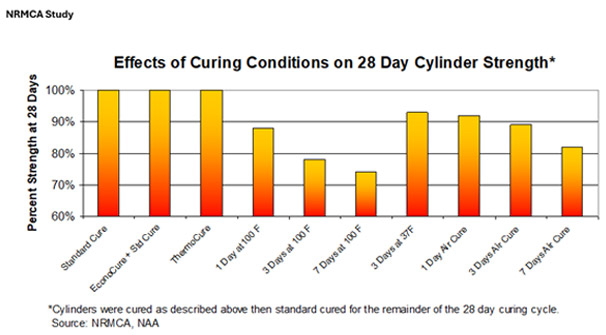
Depending on the mix design, a 10 to 15 percent reduction can translate to 300 to 600 psi or more, which is enough to turn a passing break into a failing one on paper, even though the concrete in the ground never had a problem.
What to Do About It
None of this requires special equipment or training, just attention during a step that’s easy to treat as an afterthought.
A few things worth building into a routine on any job site during hot weather, for contractors and testing labs alike:
Check where the cylinders are actually sitting, not just whether they’re covered. Shade matters more than a container.
If a cooler is being used for curing, it needs to be managed so the cylinders remain within the ASTM temperature range—not simply closed and left in the sun.
If cylinders end up sitting in a cooler with no ice, or a curing box that’s clearly holding heat, get a picture of it before they’re moved. That kind of documentation matters if a low break gets questioned later, since it’s the fastest way to tell whether the issue was the concrete or the curing.
Let’s Get Ahead of It Together
Low breaks create real headaches, delayed schedules, extra testing, and conversations nobody wants to have about whether a slab needs to come out. A lot of that can be avoided by getting initial curing right in the first place.
Concrete Supply Co.’s quality control team can walk your crew through a proper curing setup before your next hot-weather pour, or take a look at how cylinders are being handled on a job you’ve got underway right now anywhere across the Carolinas. Call us at 704-372-2930, or talk to your CSC sales rep directly, to get that set up. It’s a quick conversation that can save you from a low break that had nothing to do with the concrete itself.
Sources
- ASTM C31/C31M, Standard Practice for Making and Curing Concrete Test Specimens in the Field
- ACI 305, Guide to Hot Weather Concreting (citing Gaynor et al. 1985; Cebeci 1987)
- National Ready Mixed Concrete Association (NRMCA) / National Asphalt Association (NAA), Effects of Curing Conditions on 28-Day Cylinder Strength