
Understanding Concrete Cracks: What They Mean and When They Matter
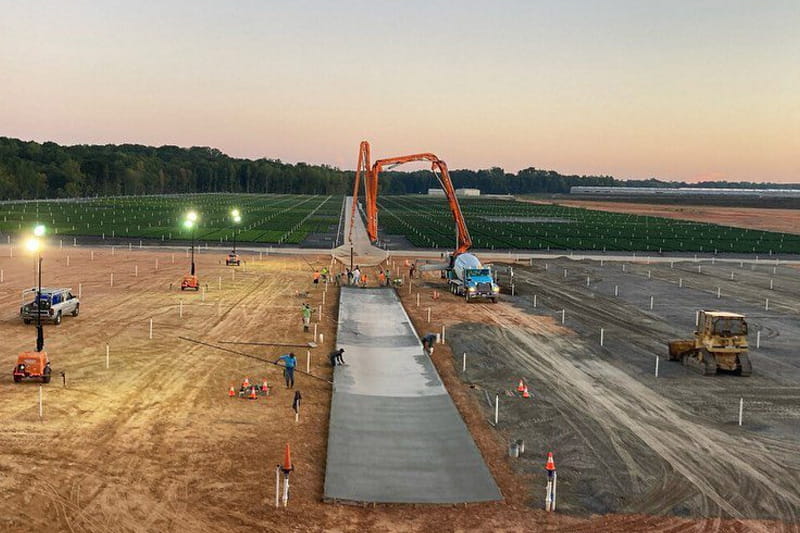
Concrete cracks. That’s not a failure—that’s reality.
Concrete is a rigid material that changes volume as it sets, dries, cools, and responds to its surroundings. Even when a slab is properly designed and placed, some cracking should be expected. What matters is why the crack formed, how it behaves, and whether it affects performance.
The American Concrete Institute makes this clear in ACI 302.1R: crack-free slabs are not a realistic expectation, and cracking alone does not indicate poor design or workmanship.
“Even with the best floor designs and proper construction, it is unrealistic to expect completely crack- and curl-free floors. Consequently, every owner should be advised by both the designer and contractor that it is completely normal to expect some amount of cracking and curling on every project, and that such an occurrence does not necessarily reflect adversely on either the adequacy of the floor’s design or the quality of its construction.”
Understanding cracking means separating normal behavior from problems that require attention.
Cracks That Form Early Don’t Wait for Strength
Some cracks form before the concrete ever has a chance to gain strength.
When concrete is fresh, it contains more water than it ultimately needs for hydration. If surface moisture evaporates faster than bleed water can replace it, the surface begins to shrink while the concrete below is still plastic. That restraint creates stress, and the slab relieves it through cracking.
These cracks often show up near reentrant corners, penetrations, and slab edges—areas where the concrete cannot move freely. They are typically narrow, but they can extend through the slab depth. Once they form, they’re permanent.
Good curing practices, wind protection, and evaporation control reduce the risk, but under aggressive conditions, early-age cracking cannot be eliminated. It can only be managed.
Temperature Movement Cracks Where Restraint Exists
Concrete expands when it warms and contracts as it cools. When that movement is restrained, cracking follows.
Slabs tied into foundations, walls, or adjacent placements rely on joints to absorb movement. When joints are missing, poorly spaced, or bridged, the concrete finds another way to relieve stress—often in long, straight cracks that follow restraint lines.
In the Carolinas, daily and seasonal temperature swings are enough to create this movement, even without extreme cold. When movement has nowhere to go, cracking is a predictable outcome.
Soil Movement Is Often the Real Driver
Concrete performs best when it’s supported uniformly. When that support changes, the slab responds.
In this region, cracking is more commonly driven by soil moisture changes than by freeze–thaw cycles. Heavy rainfall, poor drainage, irrigation, or drought can cause soil to expand or settle beneath a slab. When support becomes uneven, cracks follow.
This is frequently seen near slab edges, control joints, and areas disturbed by utility work. Poor compaction, decomposing organic material, and inconsistent moisture conditions increase the risk.
Once the slab is in service, these movements often continue. The concrete simply reacts to what’s happening below it.
Load Problems Usually Start Below the Slab
Concrete is strong in compression, but it relies on the ground beneath it to stay put.
When loads exceed what the subgrade can support—often after the soil has softened from rain—the slab deflects. Cracks form even when the concrete itself meets strength requirements.
In commercial and light industrial work, this is more often a support issue than a mix issue. Understanding expected loads, access routes, and subgrade conditions is just as important as specifying compressive strength.
Some Cracks Are Surface-Deep
Not every crack affects structural performance.
Crazing appears as fine, shallow cracks that resemble spider webs or shattered glass. It’s caused by rapid surface drying and is primarily cosmetic.
Crusting-related cracking can occur during stamping or texturing when the surface stiffens faster than the concrete below. When pressure is applied, the surface can tear around joints or pattern edges. These cracks affect appearance, not capacity.
They don’t look good—but they don’t usually compromise the slab.
Cracking Can Be Reduced, Not Eliminated
Concrete cracking cannot be prevented entirely. It can only be controlled.
Proper site preparation, jointing, placement timing, curing, and mix selection all reduce risk. None remove it. The goal is predictable cracking, where movement occurs where it’s intended and does not affect performance or durability.
When cracks appear outside planned locations, they usually point to restraint, support, or timing—not a single isolated mistake.
Most Outcomes Are Decided Before Placement
By the time concrete is on the ground, options are limited.
Cracking behavior is largely determined by decisions made earlier—how the slab is detailed, how the subgrade is prepared, how the concrete is placed, and how it’s protected during early hydration. When those elements are aligned, cracking is easier to anticipate and manage.
When they aren’t, cracks tend to surprise people later.
Managing Cracking Starts With Coordination
Cracking becomes a problem when expectations don’t match reality.
CSC works with contractors across the Carolinas to align mix design, placement conditions, and jobsite constraints before concrete is placed. That coordination helps ensure cracking behavior is understood—not guessed at—and that responsibility is shared where it belongs.
If you’re seeing cracking on an existing slab or planning an upcoming placement, your local CSC team can help evaluate conditions and align expectations before the first truck arrives.
Sources
- American Concrete Institute (ACI). ACI 302.1R – Guide for Concrete Floor and Slab Construction
- Portland Cement Association. Concrete Cracking